Socialist Vice Presidential Candidate discusses what it means to be a member of the Socialist Party.
Sunday, October 9, 2011

10/9 Independent Party Representatives
Nancy Lord, Libertarian Vice Presidential Candidate, discusses the need for tax reduction and a less powerful government. Albion Knight, Taxpayers Vice Presidential Candidate, discusses his party’s family values and pro-life position and the need to reduce foreign aid. Barbara Garson, Socialist Vice Presidential Candidate, discusses her parties desire to educate people concerning the careers that they truly desire. She also discusses a potential socialist health plans and a free trade agreement.
10/9 Independent Parties
The Socialist Mayor Bernard Sanders of Burlington, Vermont discusses the two party systems failure to acknowledge the needs of the working class and those who live below the poverty line.
10/9 2012 Values Voter Summit
During the October 7 Values Voter Summit, the First Baptist Church pastor, Robert Jeffress, conveyed to reporters his distain for potential Republican candidate Mitt Romney’s religious views. He expressed the responsibility of Christians to abstain from voting for Mitt Romney because he is a member of the Church of Jesus Christ of Latter-Day Saints or Mormonism. Jeffress described the religion as a “cult” and explained that a Christian demographic would benefit from voting for a Christian presidential candidate rather than a non-Christian candidate. The CNN Political Unit reports Jeffress dialogue during CNN’s "The Situation Room”, “I think Mitt Romney's a good, moral man, but I think those of us who are born-again followers of Christ should always prefer a competent Christian to a competent non-Christian like Mitt Romney. So that's why I'm enthusiastic about Rick Perry." Jeffress then went on to describe the Southern Baptist Convention as officially declaring Mormonism a cult.
Following the event, CNN reporters attempted to record a statement from Mitt Romney’s campaign representatives but received no comment. CNN also contacted Mormon spokesman Michael Purdy who declined the request stating that he would not comment on a “political event” (CNN Political Unit). In an attempt to thwart inquiry regarding these slanderous remarks against Mitt Romney, Texas Governor Rick Perry’s campaign officials stated that pastor Jeffress was not asked to introduce the Governor and that Perry does not support claims depicting Mormonism as a cult (CNN Political Unit). However, Tony Perkins, one of the organizers of the Values Voter Summit, stated that Perry and his campaign were informed two weeks prior to the event and agreed to have Jeffress introduce Governor Perry. Perkins then confirmed that neither the organizers or Perry’s campaign were notified of what Jeffress would say during the Governor’s introduction. Jeffress also stated that his words were not unusual or unexpected because the Church of Jesus Christ of Latter-Day Saints or Mormonism has historically never been recognized as a sect of Christianity. The pastor affirmed his assertion that responsible Christians and conservatives should not support Mitt Romney by stating, “religion aside conservatives have plenty of reasons, leaving Mormonism out of it, not to be energized by Mitt Romney's candidacy” (CNN Political Unit). Perhaps if questioned, Jeffress would not be averted to outlining the nature of these reasons.
Pastor Jeffress' comments essentially outweighed the remarks of Perry, Herman Cain, Rep. Michele Bachmann, former House Speaker Newt Gingrich, and former Sen. Rick Santorum, all of whom addressed the conservative gathering Friday (CNN Political Unit). However, Governor Perry joined his supporter Jeffress in slandering Romney’s religious and moral values by stating, "For some candidates, pro-life is an election-year slogan to follow the prevailing political winds” (CNN POLITICAL UNIT).
Links: CNN Political Unit. http://www.cnn.com/2011/10/08/politics/perry-response-mormonism/301956-101.html?hpt=po_bn1
10/9 Social Networking with Candidates
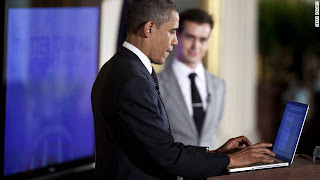
In last weeks Blog post I discussed the Obama Administration’s utilization of social networking and technological applications such as Facebook and Formspring. Micah Sifrey, cofounder of the Personal Democracy Forum, studies the changes in technology that alter the political field in presidential elections. Technology and social networking tools have reshaped the playing field for presidential campaigning. In July, a website that specializes in data mining and analytics software named KDNuggets released an unusual ad in the job listing. The ads text read, "We are looking for Predictive Modeling/Data Mining Scientists and Analysts, at both the senior and junior level, to join our department through November 2012 at our Chicago Headquarters," read the ad. "We are a multi-disciplinary team of statisticians, predictive modelers, data mining experts, mathematicians, software developers, general analysts and organizers - all striving for a single goal: re-electing President Obama.” The KDNuggets advertisement has Republicans such as Alex Lundry, a data-mining expert at TargetPoint Consulting, wondering how technologically equipped the Republican candidates campaigns are.
The Obama Administration periodically updates an “Obama” Facebook page with 23 million followers, which provides Obama’s supporters with detailed reports of his recent schedule and whereabouts. His asdministration also utilizes a social networking application on Facebook called “Obama 2012- Are You In? (Micah Sifry). The application provides the Obama Administration with invaluable information regarding personal information such as the users name, gender, birthday, current city, religion and political views. Staff workers within the Obama Administration are also using a social networking tool known as NationalField. This application allows the staff to connect and post their current assignments and achievements regarding the campaign. Micah Sifrey depicts the applications successful communication between all levels of staff and their progress concerning signing up volunteers, knocking on doors, identifying likely voters and dealing with campaign related issues. Users may also share qualitative information outlining the successful questions asked during face-to-face interactions with potential voters. However, the application differs from open-public social networks because NationalFields adheres to a hierarchial social graph; those with a higher level of clearance are afforded a broader view of their state and local coworkers activity. The Republican Party has been merely focusing on keeping their candidates somewhat involved with social networking applications, whereas Obama’s campaign is developing contemporary “social intelligence” that will allow representatives to connect with potential voters and Obama enthusiasts on a more involved level than ever before.
CNN Reporter Micah Sifrey sums up the Obama Administration’s technologically equipped social networking advantage, “Obama may be struggling in the polls and even losing support among his core boosters, but when it comes to the modern mechanics of identifying, connecting with and mobilizing voters, as well as the challenge of integrating voter information with the complex internal workings of a national campaign, his team is way ahead of the Republican pack.”
Links: Micah Sifrey. http://www.cnn.com/2011/10/09/tech/innovation/obama-data-crunching-election/index.html?hpt=hp_c1
Sunday, October 2, 2011
In this video, students from American University answer questions from CSPAN channel viewers. A man from Davenport, Iowa expresses his views on the youth vote and his appreciation for the poll. The student answers and draws on the middle-aged and elderly citizens perception of the youth as apathetic towards voting.
Subscribe to:
Posts (Atom)