Robert Woodward, professor at Drake University, discusses the meedia’s role in Iowan and national politics throughout campaings. Mr. Woodward explains that citizens attain the majority of their knowledge concerning candidates and their policies through information technology and the media. Mr. Woodward also discusses the role of local press and national broadcasts in delivering political coverage and political advertisements to citizens throughout America.
Sunday, October 30, 2011

C-Span Video 2
Republican candidate Herman Cain delivers a speech to supporters and media coverage reporters in Roosevelt Park, Detroit in order to back his “9-9-9” plan by discussing his qualifications as a former economic consultant in the early 1990’s. He also introduces his senior economic advisor, the “co-architect of ‘9-9-9,’” Rich Lowrie of Cleveland Ohio. Cain then lays out the five goals of his “9-9-9” plan: simplicity, transparency, efficiency, fairness, and revenue neutrality.
C-Span Video 1
Political Media Reporter Jennifer Jacobs is interviewed via phone regarding the reaction to the 2012 Republican candidates debate in Iowa. She explains that Romney performed well during the debate despite the arguments that ensued between his fellow candidates. Jacobs also discusses the media attraction and the historical background of the Iowa State Fair, which is perhaps the most commonly visited area by presidential candidates.
America's Jobs Plan

On October 12 Vice President Joe Biden asserted that violent crime such as murder, rape, and burglary will inevitably increase if Republicans in Congress reject the Obama administration’s proposed jobs bill. Biden’s statements do not interpret any statistical evidence and many Americans, including many non-Republicans regard these statements as arbitrary and “irresponsible” (Fox News).
The legislation in question, backed by the Obama Administration, is a $35 billion bill that would delegate $30 billion to aid state and local governments in ensuring the jobs of 400,000 teachers. The remaining $5 million will enable cities to retain jobs for 18,000 police officers and 7,000 firefighters (Fox News).
Biden responded to Congress’ defeat of the bill during a speech to Philadelphia police officers at the University of Pennsylvania,
“Let me tell you, it’s not temporary when that 9-1-1 call comes in and a woman’s being raped. If a cop shows up in time to prevent the rape, it’s not temporary to that woman,” Biden said with his voice rising. “It’s not temporary to the guy whose store is being held up and has a gun being pointed to his head if a cop shows up and he’s not killed. That’s not temporary to that store owner. Give me a break -- temporary. I wish these guys who thought it was temporary, I wish they had some notion what it’s like be on the other side of a gun or a 200-pound man standing over you telling you to submit. Folks, it matters. It matters.”
These remarks are outlandish and may be interpreted by victims of violent crimes as sponsoring a manipulative political agenda. The Vice President’s comment was an inappropriate and tactless effort to gain support for the Democratic jobs bill.
In response to Congress’ initial rejection of Obama’s $447 billion dollar jobs bill, Senate Republicans are pushing their own agenda. They have cultivated their own legislation in regards to the “jobs issue” which includes tax reform, a balanced budget amendment, a repeal of the federal health care law and lifting prohibitions on offshore drilling (Fox News).
While delivering a speech in Virginia, one stop on Obama’s bus tour to promote his jobs bill, Obama responded to the Republican proposed bill by stating, “Let me repeat, dirtier air, dirtier water, repealing health care and ending rules on Wall Street is not a jobs plan” (Fox News). Recently on his tour, Obama has made remarks in support of the jobs bill every two days, and in a different state every six days.
Senate Majority Leader, Harry Reid, provides an interesting perspective concerning the Republican Senators decision to fight the Democratic jobs bill. Henry Reid stated that the Republican Senators rejected the bill in correspondence with their political agenda, to elect a Republican president. By rejecting the bill, the crippling jobs issue will not be corrected in any way, preceding the 2012 election (Fox News).
In opposition to Obama’s statement, Senate Republican leader Mitch McConnell stated on Wednesday that Obama needs to “park the campaign bus, shelve the talking points and focus on jobs” (Fox News). McConnell points out, “It’s completely preposterous at a time when 14 million Americans are looking for a job in this country for the president to be riding around on a bus saying we should raise taxes – on the very folks who create jobs” (Fox News).
Works Cited: Fox News. http://www.foxnews.com/politics/2011/10/19/biden-evokes-sexual-violent-imagery-again-in-push-for-447-jobs-bill/#ixzz1cDcjzt4L
The “Inevitable Candidate”
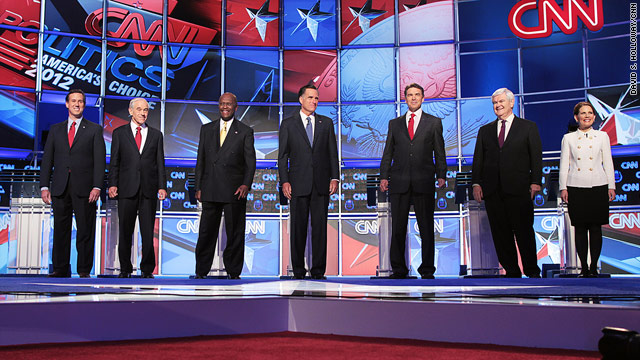
Massachusetts Governor Mitt Romney is likely to remain the dominant nominee for the Republican candidacy throughout the primary elections. However, polls suggest that Romney has not secured his seat as the prevailing candidate just yet. Polls in Iowa reveal, “24% of registered Republicans say they are backing Romney, who's making his second bid for the presidency, with Cain, the former Godfather's Pizza CEO and radio talk show host, at 21%. Romney’s three-point margin is within the surveys sampling error” (Paul Steinhauser). The polls results, a three-point gap separating leading nominees, highlights the “undecided” stance of Republican voters.
Yet, many perceive Mitt Romney as the “inevitable candidate” because he is regarded as the “candidate to beat Obama.” Romney has established assertiveness throughout the Republican debates and cultivated a tight knit campaign that has potential to win the presidential election. However, precedent suggests the “most likely to win” nominee is not necessarily accepted as the most appropriate candidate to represent Party policies. In 2004, Howard Dean, Democratic presidential nominee, emerged as the party’s most progressive candidate (Joe Trippi). Dean’s anti-war, anti-Bush stance sat well with Democrats who did not support the Washington Democrats decision to “go-along” with the Bush administration’s Iraq war (Joe Trippi). However, the overall Democratic Party sentiment conveyed Senator John Kerry as the most “likely to win” against Bush. The Iraq war became a major issue during the election, and Kerry’s pro-war stance did not gain him excessive popularity. A poll taken at the 2004 Democratic National Convention found, ““Eighty percent of [delegates] polled said they opposed the decision to go to war against Iraq at the time it began, and 95 percent say they now oppose the war. A majority of 63 percent want U.S. troops out within two years; only one in four say the United States should stay as long as it takes to achieve administration goals” (Joe Trippi).
Romney is currently facing similar adversities and is the subject of Republican voter speculation concerning his campaigns health policy. “RomneyCare” is regarded as the genesis of the highly disputed national “ObamaCare” plan. If Conservative Republicans feel “disenfranchised” by Romney’s proposed health plan and his puzzling stance on abortion, they may display ambivalent and apathetic views toward the GOP’s nominees. Matt Kibbe, president of the Tea Party aligned FreedomWorks, points out that voter turnout may be effected if Republicans do in fact feel “disenfranchised” by the lack of representation concerning their political stance on popular issues, such as abortion and healthcare (Joe Trippi). In September 2004, sixty-five percent of Bush supporters claimed to be “very enthusiastic” about their candidate, whereas only forty-two percent of Kerry supports displayed strong enthusiasm (Joe Trippi). This discrepancy in voter enthusiasm compliments Matt Kibbe’s speculation, that if conservative voters are disenfranchised or unenthused by their candidate, than voter turnout may be significantly effected. One Wall Street Journal/NBC poll revealed, forty percent of Republicans stated that they would vote for Romney “with some reservations.” Also, Public Policy Polling discovered that sixty-nine percent of Romney’s supporters claimed that they “might end up supporting someone else in the primary” (Joe Trippi).
Governor Mitt Romney, the “inevitable candidate,” may in fact become the Republican candidate for the 2012 election. However, the commonly noted cliché, history repeats itself, may have relevance concerning Republican support and voter turnout during the general election.
Works Cited: Paul Steinhauser, CNN Deputy Political Director. http://politicalticker.blogs.cnn.com/2011/10/26/poll-romney-at-or-tied-for-top-spot-in-first-4-states-to-vote/?hpt=hp_bn3.
Joe Trippi, Fox News. http://www.foxnews.com/opinion/2011/10/24/romney-will-wind-up-as-gop-nominee-but-will-party-faithful-have-regrets/#ixzz1cDGGzQwd.
Subscribe to:
Posts (Atom)